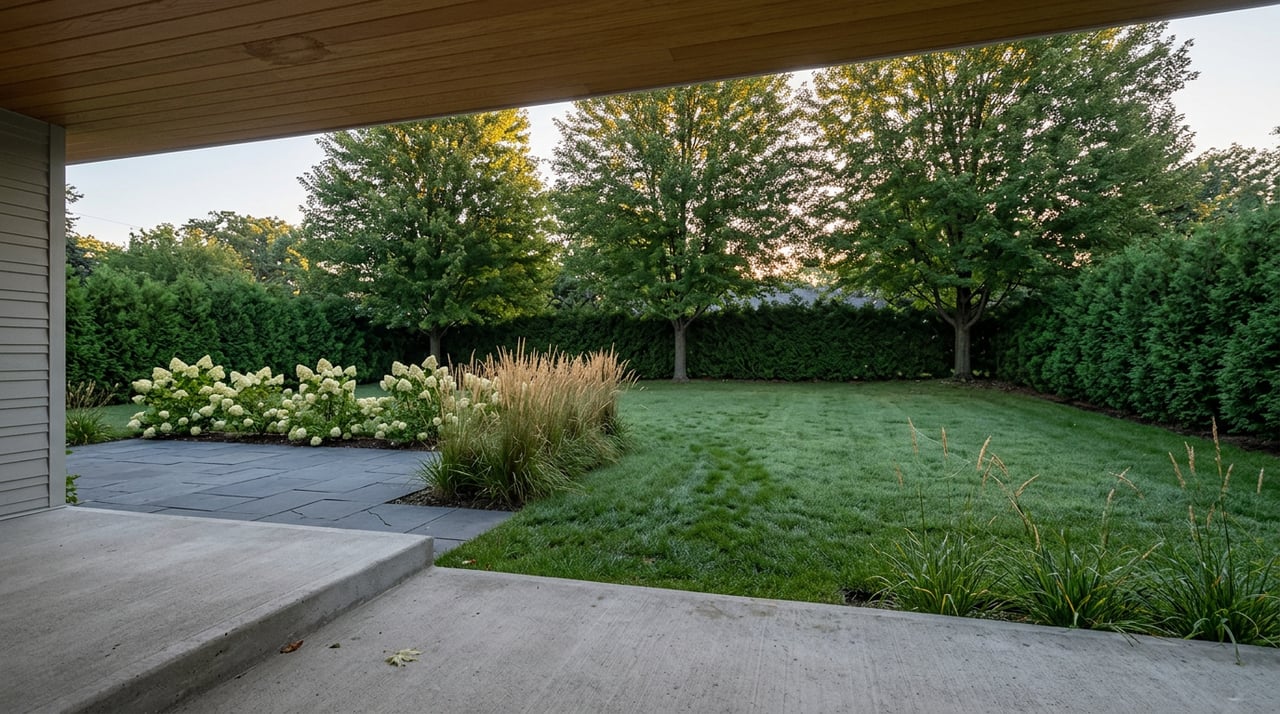
Eight in the morning at the Brown County Dog Park and the gravel lot off Pleasant Lane is already half full. Regulars know this. They know the small-dog gate sticks a little in humidity, they know which corner of the big-dog run still holds water after rain, and they know that if you want the fenced yard to yourself, you come before the school buses start running or you wait until closer to sunset. What they may not know, or may only half know from a confusing map or a friend's warning, is what happens once you leave that fence line and try to keep walking.
The dog park is the finished part of Hobart's outdoor life. The trail that runs past it toward Howard and Oneida is not, and knowing the difference changes how you plan a Tuesday evening walk versus a weekend ride.
What's Actually Done
Brown County Dog Park sits at 1000 Pleasant Lane, right along Duck Creek, and it works exactly the way a finished public amenity should. The off-leash fenced area covers more than four acres, split into sections for large dogs, small dogs, and a separate puppy-only run so a nervous ten-week-old lab mix isn't getting bowled over by somebody's boxer. Agility equipment is scattered through the yard. A self-pay station handles the fee, which runs $15 per dog for an annual pass or $2 per visit if you're just passing through. The park stays open year-round from 8 a.m. to sunset, no seasonal closures, no reservation system, no surprises.
That predictability is the point. You know what you're getting before you get there. The creek runs along the property line, the trails inside the fence follow the perimeter, and the only real variable is how muddy things get after a heavy rain, which multiple regulars mention as the one recurring complaint.
Compare that to what's supposed to happen once you walk out the back gate.
The Trail the Map Promises
The Duck Creek Trail is a crushed-limestone rail corridor that, on paper, connects a lot more than a dog park. It starts at the eastern end of the Newton Blackmour State Trail near Seymour, runs east through Oneida Nation land in Outagamie County, and continues into the Village of Oneida, a stretch of roughly seven miles. The long-term vision extends it further east into Hobart and eventually to Pamperin Park in Green Bay, which would turn a fragmented set of local paths into one continuous route linking Howard, Hobart, and Oneida.
That connector project finally broke loose in 2023, after roughly a decade of delays. When it did, Village of Hobart Trustee Vanya Koepke laid out three goals for it: connect the municipalities to each other, build out recreation, and give people a reason to walk or bike the corridor whether they live in Howard, Hobart, or Oneida or are just visiting from outside. It's a good vision, and it had real institutional weight behind it from the start.
But a vision and a finished trail are two different things, and Hobart is still living in the gap between them.
What Actually Happens Past the Fence Line
Ask anyone who has tried to ride the full corridor and you get a range of answers depending on exactly which stretch they hit. The Seymour end, closer to the Newton Blackmour connection, tends to get the best reviews: wider surface, better maintenance, rideable on a standard road bike. Move east toward Oneida and the trail head sunk in ambiguity for more than one rider. One person searching for the Green Bay side trailhead described giving up and driving north to park at a church lot instead, because no markers indicated where the corridor actually began.
Closer to Hobart itself, the reports get more inconsistent. Some describe the stretch as decent gravel, workable on a hybrid or gravel bike. Others describe sections near Duck Creek Park as overgrown, with fallen trees blocking passage entirely, more suited to a determined hike than anything on two wheels. At least one rider noted that trail maps show the corridor reaching Hobart when in practice the usable path stopped short in Oneida, a gap between what's charted and what's walkable that anyone planning a long loop needs to know about before they commit an afternoon to it.
None of this means the project has failed. It means the trail is still being built out in pieces, and the pieces closest to Hobart are the least finished right now. That's a very different message than "come bike the seven-mile connector," and it's the kind of distinction a map alone won't give you.
Reading the Trail by Season
Weather changes the calculation too. Spring runoff turns the softer, ungroomed sections boggy enough that more than one visitor has flagged deep, fast-moving water crossing sections of the corridor near the creek. Late summer, which is where the calendar sits now, tends to dry things out and make even the rougher stretches passable on foot, though overgrowth from a full summer of unchecked growth can still close in on narrower sections. Winter brings snowmobile traffic to parts of the corridor near Newton Blackmour, since the trail there allows shared use, while the fenced dog park stays open and usable regardless of season because it's maintained on a completely different schedule.
The practical upshot: the dog park is a known quantity twelve months a year. The trail's reliability shifts with the calendar and with exactly which segment you're on, and treating the whole seven-plus mile corridor as one uniform experience is the mistake most first-time users make.
What This Means If You Actually Walk This Route
If you live near Pleasant Lane and want a daily loop you can count on, the dog park's internal perimeter trail is the sure thing. It follows the fence line the entire way, stays maintained regardless of season, and gets you time along Duck Creek without any guesswork about trail conditions three miles down the line.
If you're thinking bigger, treat the broader Duck Creek corridor as a project in progress rather than a finished amenity. The Seymour-to-Oneida stretch is the most reliable long ride today. The push east into Hobart and eventually toward Pamperin Park is real, it has a named village trustee and a stated set of goals behind it, but it is not yet the continuous town-to-town connector the long-term plan describes. Anyone planning a longer ride or hike is better served checking current trail conditions before setting out than assuming the map matches the ground.
That gap between plan and reality is not a knock on Hobart. It's what a growing village's infrastructure actually looks like mid-build, and it's useful to know exactly where you stand in that process rather than finding out the hard way three miles past the last trail marker.
The Bigger Picture
Hobart's outdoor amenities tell a story about a village that's investing in connection, literally, between itself and its neighbors. The dog park at Pleasant Lane already delivers on that promise every single day. The Duck Creek Trail is catching up, and the fact that a named village trustee has staked real goals on finishing that connection says something about where local priorities sit right now. For anyone who already calls Hobart home, that's worth knowing before your next long walk, not after.
If you're curious how these kinds of local details, the finished amenities and the ones still coming together, shape what a property here is actually worth, Sandra Ranck and her team track that ground-level texture across Hobart and the rest of Brown County every day. Reach out for a complimentary home valuation or to talk through what a listing consultation looks like when it's built on knowing a neighborhood this closely.